Three Shades Of A Banch
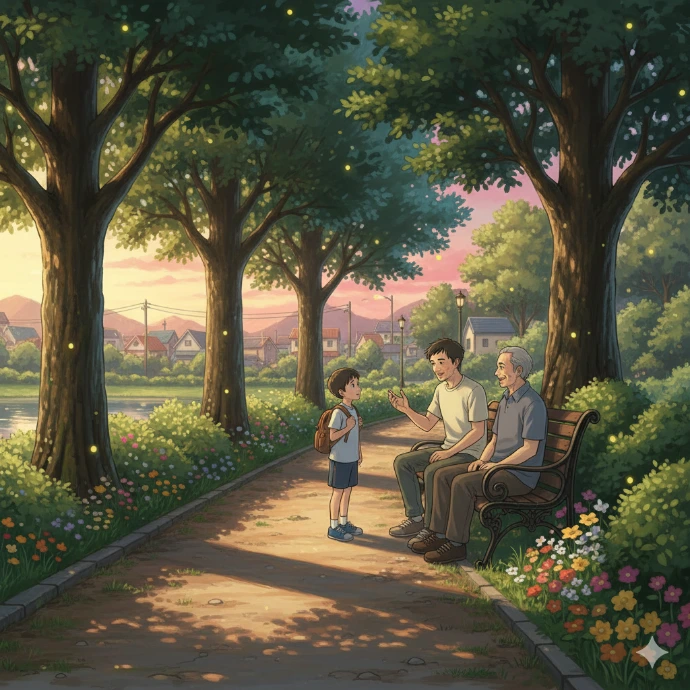
The city moved around them in a blur—cars honking, people rushing, the distant wail of sirens—but in a quiet corner of a small park, time slowed. Amid the rustling leaves and the gentle sway of branches, there stood an old wooden bench. Its paint was chipped, its surface worn smooth by countless visitors over the years, yet it held a quiet dignity, as if it had absorbed all the stories whispered into the air around it.
That evening, the sun hung low in the sky, spilling golden light across the park, turning ordinary leaves into flames of amber and crimson. On that bench, three strangers sat together, each carrying a life shaped by different decades, different choices, and different regrets.
Adi, ten, fidgeted with the edges of the seat, his eyes wide with wonder. To him, life was a playground of endless possibilities—superheroes, bikes, toys, and dreams bigger than the sky.
Aman, twenty-nine, slouched slightly, weighed down by responsibilities he could neither escape nor fully embrace. Dreams he once held tightly now felt like distant stars, beautiful but unreachable.
Dipak, fifty-six, moved with the careful deliberation of years lived under obligation. His hair had grayed, his back ached, and his heart carried the quiet burden of opportunities missed, moments lost, and words never spoken.
Yet here they were—three lives intersecting on a single worn bench, under a sky painted with the last light of day. And though they did not know it yet, in the silence between them, something extraordinary was beginning.
Because sometimes, all it takes is a place to sit, a conversation to start, and the courage to see life differently.
Prologue: The Bench in the Park
The city was never truly quiet, but in one forgotten corner, where the roads narrowed into gravel paths and the tall buildings gave way to trees, silence had found a place to rest.
This corner held a small public park, unremarkable to most. It did not boast fountains or manicured flowerbeds. The swings creaked from rust, the grass grew unevenly, and the lamps flickered with a faint orange glow at dusk. Yet, to those who stumbled upon it, the park was a pause button in a life that rarely slowed down.
At the heart of this sanctuary stood a bench—wooden, weather-worn, and sturdy despite its cracks. The green paint had peeled away in patches, leaving behind bare wood that had endured rains, summers, and countless afternoons of waiting. The bench was neither beautiful nor grand, but it had one unique quality: it listened.
For years, it had carried the weight of strangers, their sighs, their laughter, their whispered secrets. Lovers had carved initials into its armrest; an old man had once left his newspaper folded neatly on it; children had used it as a stage for their games of make-believe. Time had touched it, but it remained—anchored, patient, and still.
That evening, the park glowed under the golden wash of sunset. The air was heavy with the scent of wet earth, for a drizzle had passed not long ago. Pigeons circled overhead before settling on branches, and somewhere in the distance, a vendor’s bell rang as he sold roasted peanuts wrapped in paper cones. The city outside hummed in urgency, but here, only the rustle of leaves and the faint laughter of children reached the ear.
It was on this evening that the bench welcomed three visitors—each carrying a different weight, each unaware of how this ordinary seat would bind their lives together, if only for a short while.
Adi was the first to arrive. A boy of ten, his hair messy from running, his eyes shining with curiosity. He skipped more than he walked, dragging behind him a schoolbag that looked heavier than his small frame could carry. To him, the bench was not a relic but a throne. He clambered onto it, swinging his legs freely, tapping his shoes against the wood as if making music. The world to Adi was wide and open, a place where every shadow could hide a superhero and every cloud could be tamed into a dragon.
Not long after, Aman appeared. Twenty-nine, his shirt slightly crumpled, his tie loosened after a day at work. His steps were not heavy, but they carried the fatigue of someone who had been running for years without stopping. He spotted the boy on the bench, hesitated for a moment, and then sat down at the far end, careful not to intrude. His phone buzzed in his pocket, but he ignored it for once. He leaned back, closed his eyes briefly, and exhaled. In that sigh lay the weight of bills unpaid, dreams postponed, and questions left unanswered.
Finally, Dipak came. Fifty-six, his hair tinged with silver, his gait slow but steady. He carried with him the dignity of age, though his shoulders drooped as if years of responsibility had bent them slightly. He did not rush to the bench. Instead, he paused, watching the park as though it were a painting he had seen before, one that evoked both nostalgia and regret. When he finally lowered himself onto the remaining space, the wood creaked softly under his weight, as if recognizing an old friend.
Three people. Three lives. Three stages of existence.
They did not speak immediately. The silence between them was not awkward but thoughtful, like the quiet one feels when watching a fire burn low or when listening to the rhythm of rain. The boy glanced at the man beside him, then at the elder. Aman adjusted his sleeve, while Dipak ran a hand across the bench’s rough surface as though tracing old scars.
The golden light filtered through the canopy of trees, falling on their faces like a painter’s brush. Adi’s youthful face glowed with unspent energy. Aman’s features were taut, sharpened by ambition and restlessness. Dipak’s eyes carried shadows, softened by memories and unspoken regrets. They were strangers, yet the bench gathered them like chapters of the same book—different, but bound by a single spine.
Somewhere nearby, a swing squeaked, keeping time with the tick of a clock unseen. A dog barked, chasing after nothing in particular. Life, with all its noise and motion, moved around them. But here, in this small clearing, time seemed to pause—long enough for a boy, a man, and an elder to sit together, not as strangers divided by years, but as travelers resting at the same milestone.
And though none of them realized it yet, this evening would carve itself into their memories. They had come to the bench with their own stories—one filled with dreams, another with struggles, and the last with regrets. But before they left, they would discover something rare: that in the stillness of a park, under the watchful eye of an old bench, three lives could find meaning in each other.
The breeze picked up, carrying with it the scent of damp soil and blooming jasmines. Adi swung his legs faster, Aman straightened his back, and Dipak finally allowed himself a small smile. The bench had seen many things, but tonight it was about to witness something it would hold in its wooden silence forever.
Chapter 1: Adi – The Dreamer
Adi never sat still. Even on the bench, his legs swung like pendulums, tapping out rhythms against the air. His eyes wandered everywhere—toward the pigeons picking at crumbs, the shadows growing longer under the trees, the orange sky that looked to him like a painting still wet with color.
He was ten, and the world to him was not a burden but a playground. His mind, like a kite untethered, soared wherever it wished. In his head, he was not just Adi, son of Meera and student of Class V—he was an inventor, a superhero, an explorer of worlds unseen.
“Do you know,” he suddenly said aloud, looking at Aman beside him, “that when I grow up, I’ll buy the biggest bike in the world? It will be red, with silver wings, and it will fly higher than the clouds.”
Aman turned his head, amusement flickering across his tired face. “The biggest bike, huh? And where will you keep this flying giant?”
Adi puffed up his chest. “I’ll build a floating shelf in the sky. All my toys and my bike will stay there. Nobody can touch them. Not even thieves.”
Dipak, who had been watching quietly, chuckled softly. “When I was your age, Adi, I wanted a spaceship made of candy. Chocolate wings, biscuit windows, laddoos for wheels. Dreams taste sweetest when you’re young.”
Adi’s eyes widened. “A spaceship made of candy? That’s… that’s genius! Why didn’t you build it?”
“Life,” Dipak replied, his smile carrying both warmth and a faint shadow. “Life doesn’t always leave room for candy spaceships.”
The boy thought about this for a second, then dismissed it with a wave of his hand. “Then I’ll build both. My flying bike and your candy spaceship. We’ll race in the sky!”
Aman laughed for the first time that evening, a genuine laugh that lifted some of the heaviness from his shoulders. “If you build that, Adi, I’ll be the first one to buy a ticket.”
The night before, Adi had asked his mother a question that still buzzed in his head. He had been sprawled on the floor with his crayons, drawing a crooked picture of himself with a cape, when he asked, “Maa, do grown-ups really eat ice cream whenever they want?”
His mother, brushing his hair away from his forehead, had smiled. “Yes, they can, Adi. But sometimes… they forget how to enjoy it.”
He didn’t understand. How could anyone forget to enjoy ice cream? Grown-ups, he thought, were strange creatures. They had money, freedom, and phones that could play games all day, yet they always seemed worried, frowning at papers or staring into nothing.
But Adi’s world was different. His dreams were simple, wild, and unashamed. He dreamed of becoming a superhero—not to save the world, but to buy toys for every child who didn’t have one. He imagined inventing a pencil that wrote in rainbow colors, a backpack that turned into a parachute, shoes that could make you invisible during exams.
And he spoke of them freely, without fear of being laughed at.
“Adi,” Aman asked, leaning forward, “why do you want the biggest bike? Why not something else?”
The boy answered without hesitation. “Because bikes mean freedom. I see people ride and go anywhere they want. No one can stop them. When I ride, I’ll go far away, maybe even to the mountains. I’ll never be late to school. And everyone will look at me and say, ‘Wow, that’s Adi!’”
Dipak looked at the boy with something like nostalgia. “I once dreamed of a kite so big it could carry me across the sea. I wanted to see the world, Adi, just like you want to ride your bike.”
Adi grinned. “See? We both like flying things. Maybe we are cousins from a past life!”
Aman ruffled the boy’s hair, smiling. “And what if the bike breaks? What if you can’t buy it?”
Adi frowned, as though the idea itself was silly. “Then I’ll dream of something else. You can’t stop dreams, bhaiya. They just… find another way.”
His words, innocent as they were, landed heavily on Aman and Dipak. To Adi, dreams were rivers—they flowed, they changed paths, but they never dried up. To the men beside him, dreams often felt like walls, tall and unscalable.
The boy could not see the burdens on their faces. He only saw companions, people who listened to his stories. And so he spoke more.
“I’ll also buy toys. Not just one or two, but every toy in the world. Cars that drive by themselves, robots that do homework, footballs that never lose air. And I’ll build a toy city. Anyone can come and play. There will be no exams there, only fun.”
“Sounds like paradise,” Aman muttered, half to himself.
“It is!” Adi beamed. “And guess what? Even old people like you, Uncle—” he pointed at Dipak, who laughed, “—can come play! You’ll get free laddoos at the gate.”
Dipak raised an eyebrow. “Free laddoos? Then I’ll definitely visit your city.”
They laughed together, their voices blending into the rustling of leaves.
Adi’s imagination painted the world in colors others had long forgotten. He saw possibilities where others saw problems. To him, the broken swing was not broken—it was a rocket waiting to launch. The cracked bench was not weary—it was a throne that carried kings, dreamers, and storytellers.
He did not yet understand the weight of bills, the silence of loneliness, or the ache of regret. His world was painted with crayons, not worries. And though his dreams might have been naïve, they carried a truth older than time: that every invention, every story, every change in the world began in the unchained heart of a dreamer.
As the sun lowered further, Adi’s words slowed, his eyelids heavy with the kind of tiredness that comes not from work but from boundless excitement. He leaned against the bench, humming a tune to himself.
Dipak watched him and whispered, almost to himself, “Let children dream. Encourage them, guide them, but never clip their wings. For in their dreams lies the foundation of tomorrow.”
Aman nodded silently, his gaze fixed on the boy. Somewhere deep inside, he felt a flicker—a reminder of his own childhood dreams, buried under files and deadlines.
The park grew dimmer, but for a moment, under the laughter of a boy, the burdens of two weary men felt lighter.

Chapter 2: Aman – The Struggler
Aman sat in the middle of the bench, but it wasn’t just a position—it was his life. He was balanced uncomfortably between the innocence of childhood and the wisdom of age, between the hunger for dreams and the heaviness of responsibilities. At twenty-nine, he should have felt the world at his feet. Instead, he felt as though the ground beneath him was always shifting.
His phone vibrated in his pocket, and though instinct urged him to check it, he resisted. He already knew what it would be: a reminder from the bank, a message from his landlord, or an email marked “urgent” from his boss. The buzzing stopped, but the pressure lingered, like an itch that could not be scratched.
He ran his hand through his hair, staring out at the trees. “Sometimes,” he said quietly, “I wonder if I’m really living… or just surviving.”
Adi tilted his head, puzzled. “But bhaiya, you have a bike and a phone. That’s like… having superpowers!”
Aman smiled faintly, not with joy but with weariness. “Yeah. But superheroes get tired too.”
Dipak’s gaze shifted toward him, steady and knowing. “Do you ever feel,” the older man asked, “like you’re not the hero in your own story?”
Aman thought for a moment, then exhaled. “More like I’m an extra in someone else’s.”
His days all looked the same.
Morning began with alarms that dragged him out of sleep, emails waiting even before breakfast, and hurried commutes through crowded buses or choking traffic. His office was a gray cube, filled with the clatter of keyboards, the drone of air conditioners, and the constant hum of demands. He smiled when needed, nodded when required, and typed until his wrists ached.
There was always another deadline, another project, another task that “couldn’t wait.” But when it came to his own life—his travels, his writing, his unpursued hobbies—everything was postponed. Tomorrow, next month, someday.
He often stared at the travel posters on the metro walls—mountains, seas, winding roads—and felt a pang deep in his chest. He longed to feel the wind on his face in a faraway land, to write stories not for clients but for himself, to take photographs that captured more than office parties. But then his phone would buzz, reminding him of the bills waiting at the end of the month, and he would step off the train into another long day.
One memory in particular haunted him.
It was two years ago. He had been rejected from a job he desperately wanted, one that promised both financial relief and creative satisfaction. He remembered standing at the train station that night, the cold railing pressed against his hands. The city lights blinked at him, indifferent, like stars too far away to care. He had not cried. He had only stared at the empty tracks, wondering if life ever paused for anyone. The train eventually came, carrying tired faces home, and he boarded, another nameless passenger swallowed by routine.
“Do you write, Aman?” Dipak’s voice pulled him back to the present.
Aman hesitated. “I used to. Stories. Little things. But now… I barely write texts that aren’t for work.”
“Why?” Adi asked innocently. “If you like writing, just write. Simple.”
The man laughed dryly. “Simple for you, maybe. But when you grow up, Adi, you’ll see. Time isn’t always yours. It belongs to your boss, your family, your bills. You barely get to borrow it for yourself.”
Adi’s brows knitted. “But Maa says everyone has the same twenty-four hours. Don’t you?”
Aman looked at him, a little stunned. The boy’s question was sharper than he expected. “Yes. But some hours weigh heavier than others.”
Dipak nodded slowly, as though he understood too well. “Responsibilities… they steal more than time. They steal pieces of yourself.”
The pressure wasn’t only financial.
At home, Aman’s parents often reminded him of his “age.” Twenty-nine was, to them, the threshold of serious adulthood. “When will you settle down?” his mother asked almost daily. “Your cousin is already married. Your friend has two children.” His father spoke less, but his silence was heavier—filled with expectations unspoken but loud.
There was also the matter of the girl he once loved. A colleague, bright-eyed and gentle. They had shared lunches, exchanged dreams, and even spoken of a future. But the weight of instability crushed it. She wanted certainty, a path paved with confidence. He could not offer that. Eventually, she left—not angrily, but with quiet disappointment. Now, when Aman thought of her, it wasn’t the memories that hurt most—it was the “what ifs.”
On the bench, he admitted softly, “Sometimes I feel like I’m chasing life, but it’s always two steps ahead. No matter how fast I run, I can’t catch it.”
Adi looked confused, but he tried to offer comfort. “Maybe you just need faster shoes.”
The boy’s simplicity made both men smile. For a brief moment, Aman envied him—not for his toys or his freedom, but for his ability to believe that problems had simple answers.
That night, Aman would return to his small rented room, its walls lined with unpaid bills and unfinished drafts of stories he never shared. He would scroll through social media, seeing friends traveling, getting promotions, building families, and he would feel a quiet ache. Not jealousy, exactly, but a loneliness that came from comparing his life to others’.
And yet, beneath the weight of exhaustion, a tiny ember still burned. The desire to write again. To travel, even if just once. To feel alive, not just necessary. He carried that ember like a secret, hidden even from himself most days.
On the bench, under the fading light, Aman whispered something he rarely admitted:
“I want to live. Not just pay rent and tick boxes. I want to stand somewhere—anywhere—and feel like I belong to that moment. Even if it’s only for a day.”
The boy clapped his hands. “Then do it, bhaiya! Promise me you’ll do one fun thing this week.”
Dipak looked at Aman with quiet intensity. “He’s right. Don’t wait too long. Life doesn’t send reminders the way your phone does.”For a moment, Aman allowed himself to imagine it. A trip. A story published. A day spent not worrying about tomorrow. And for the first time in a long while, it didn’t feel impossible.

Chapter 3: Dipak – The Forgotten Man
Dipak sat at the edge of the bench, his hands folded neatly over his knees, as though life had trained him into discipline even in rest. His hair, once thick and dark, was now streaked with gray. His shoulders curved slightly forward, not just from age but from years of bending—bending to work, bending to responsibilities, bending to everyone else’s needs.
He watched the boy and the young man beside him and smiled faintly. To them, the world was still a question mark—full of choices, mistakes, possibilities. For him, it had become a period, an ending to sentences he never got to rewrite.
“Uncle,” Adi asked suddenly, breaking his thoughts, “why do you always sit here alone? Don’t you have friends?”
Dipak chuckled softly, though the sound carried a tinge of sadness. “Friends… yes, once. Now, most are too busy. Some live far away. And a few… well, life took them before time could.”
Aman glanced at him. “And family?”
“Family,” Dipak repeated, the word lingering on his tongue like something sweet and bitter at once. “I have them. A wife, two children. They love me, I know. But love changes shape as years go by. At first, it’s loud and bright. Later… it becomes quiet. Almost invisible.”
Dipak’s days were not empty—far from it.
Every morning, he rose before the sun, not because he loved dawn but because habits refused to let him sleep. He prepared tea, flipped through the newspaper, circled the classifieds out of habit though he had long stopped searching for jobs. Then came the endless errands—grocery shopping, paying bills, standing in queues.
At home, his children—both in their twenties—were glued to screens. They didn’t dislike him; they simply didn’t notice him. His wife spoke to him about expenses, neighbors, or relatives, but rarely about dreams or feelings. He was useful, reliable, always there. But somewhere along the way, he had become background noise, the quiet hum of a fan that everyone depends on yet no one thanks.
He often thought of his younger days.
He remembered being twenty-two, standing outside a cinema hall with his friends, laughing so hard his stomach hurt. He remembered the first time he rode a bicycle down a slope, the wind tearing at his eyes. He remembered holding his newborn daughter for the first time, his hands trembling not from fear but from overwhelming joy.
Life had been made of sharp, vivid moments. Now it was made of routines—blurry, repetitive, predictable.
“Uncle,” Adi’s voice cut through his reflection, “what did you want to be when you were my age?”
Dipak’s eyes softened. “A teacher. I loved books. I wanted to tell stories, to explain things, to see the spark in someone’s eyes when they understood.”
“What happened then?” Aman asked quietly.
Dipak sighed. “Life. My father fell ill. Someone had to earn. I took a job in an office—steady, safe. One month turned into ten years. Ten into twenty. By the time I looked back, the dream had become a story I told myself before sleeping.”
The boy’s face scrunched in confusion. “But why didn’t you try later?”
“Because later,” Dipak said, his voice almost a whisper, “was always too late.”
He remembered the day his daughter got married. Everyone was smiling, music was playing, the house was lit with colors. But in a corner, Dipak sat with tears in his eyes—not from sadness, but from the realization that life had slipped past him. She hugged him tightly before leaving, whispering, “Papa, you’ve done so much for us. Don’t forget yourself.”
Yet years later, he had forgotten. Or perhaps he never really remembered.
“Do you know the hardest part of growing older?” Dipak asked them.
Aman shook his head. Adi leaned forward, curious.
“It’s not the wrinkles, not the aches in your bones, not even the slowing of time. It’s invisibility. People stop asking how you are. They assume you’re fine. They only call when something needs fixing, or when advice is required. You become… a chair. Always there, always useful, rarely noticed.”
A silence followed his words. Even Adi, who usually had a playful response, stayed quiet.
And yet, Dipak was not bitter.
He found joy in small things: the aroma of fresh tea, the laughter of children playing outside, the sudden coolness of an evening breeze. Sometimes he sat on his terrace at night, staring at the stars, wondering which of them were older than his regrets.
He often wrote small notes in an old diary—thoughts, poems, memories. No one knew about this habit, not even his wife. It was his secret rebellion against invisibility. His words might never be read by others, but at least they existed. At least they carried a piece of him.
“Uncle,” Aman said softly, “don’t you ever feel angry? That you gave up so much?”
Dipak thought carefully. “Angry? No. Sad, sometimes. But not angry. You see, life is not about balance—it’s about trade. I traded my dreams for my family’s safety. I don’t regret the trade. I only wish I had bargained better.”
The honesty in his tone struck Aman deeply. For Adi, the words were too heavy to fully grasp, but he sensed the weight nonetheless.
The boy, trying to lighten the air, grinned. “But uncle, you’re not invisible to us. You’re like… our wise old wizard!”
Dipak laughed, genuinely this time. “A wizard, am I? Well, if only I had magic to turn time back.”
Aman looked at him intently. “Maybe magic isn’t about turning back. Maybe it’s about using what time you still have.”
Dipak’s gaze lingered on the young man. In Aman’s tired yet restless eyes, he saw a reflection of his younger self—the self who still believed tomorrow could be different. For a moment, hope stirred inside him, fragile but alive.
That evening, as the sun dipped below the horizon, painting the sky in hues of orange and violet, Dipak whispered something almost to himself:
“Perhaps… it’s not too late to be seen again.”
Adi, hearing it, smiled wide. “See, you are a wizard. You just cast a spell on yourself.”
All three laughed together, the sound blending with the fading breeze. For a brief moment, Dipak did not feel invisible. He felt present, alive, acknowledged.

Chapter 4: A Benchside Epiphany
The last traces of sunlight stretched across the park like golden threads, weaving through branches and pooling on the ground in shifting patterns. The day was fading, yet the three figures remained seated on the bench, as though time itself had slowed to listen.
Adi swung his legs, too short to reach the ground, humming a tune only he knew. Aman leaned back, staring at the sky where the first star dared to appear. Dipak sat with his hands folded, his gaze far away, as though searching for something he had lost long ago.
For a while, silence sat with them—comfortable, unforced. The kind of silence that isn’t empty, but full. Full of thoughts unspoken, hearts half-opened, lives momentarily overlapping.
It was Aman who broke it.
“You know,” he said, his voice soft but steady, “we spend so much of life waiting. As a child, you wait to grow up. As an adult, you wait to succeed. As you get older, you wait to rest. But in all that waiting, maybe… we forget to live.”
Dipak nodded slowly. “You’re right. Waiting is the thief of life. I waited to become a teacher. I waited for vacations. I waited for retirement. And now, I wonder—what exactly was I waiting for?”
Adi tilted his head, confused. “But… waiting is normal, na? I’m waiting for my birthday next week. Maa said she’ll get me a cake shaped like a rocket!”
Both men smiled at his innocence. Dipak placed a hand on his shoulder. “Yes, beta. Birthdays, surprises, holidays—those are happy waits. But don’t let waiting become the story of your life.”
Aman looked at Adi, almost envious of his purity. “When I was your age, I thought adulthood was magic. Freedom, choices, fun. But it’s… heavier. Like carrying a backpack full of bricks everywhere you go.”
Adi giggled. “Then just drop the backpack, bhaiya!”
The boy’s laughter was so genuine that even Dipak chuckled. “If only it were that simple, Adi. Some bricks are responsibilities. Some are expectations. Some are regrets. Hard to drop them without hurting someone.”
The breeze grew cooler. Somewhere in the distance, the swing groaned as the last child left the park. The air smelled of jasmine and damp earth.
Dipak sighed. “Sometimes I wonder if life is just a bench like this. We come, we sit for a while, we leave. Different people sit beside us for different times. Some stay, some don’t. But the bench… it stays.”
Aman thought about it. “So the question is—not how long we sit, but what we do while we’re here?”
“Exactly.”
The boy, restless, jumped up and ran a small circle around the bench before plopping back down. His eyes gleamed. “I know! Let’s make a promise. Each of us! So this bench remembers us.”
Dipak raised an eyebrow. “And how will a bench remember us?”
Adi grinned mischievously. “Because we’ll remember. And that’s enough.”
Aman’s tired expression softened. “Alright, kid. What promise will you make?”
Adi sat straight, puffing out his chest. “I promise I’ll enjoy being a kid. I won’t rush to grow up like everyone says. I’ll eat ice cream slowly, and play with my toys like they’re real. And I’ll tell stories to myself every night.”
Dipak smiled warmly. “Good. Childhood should never be hurried. It’s the only time you’re truly free.”
Aman leaned forward. “Then I’ll make mine. I promise I’ll chase at least one dream, no matter how small. Maybe travel. Maybe writing. Something that’s mine—not just my job or my duty.”
There was a quiet determination in his voice. Dipak saw in him the spark he himself had once buried.
“And you, uncle?” Adi asked eagerly.
Dipak’s eyes glistened as he spoke. “I promise… to take back my time. Even if it’s late, I’ll live in moments, not just years. I’ll tell my children stories. I’ll cook dinner for my wife. I’ll sit in the park without guilt. I’ll… be present.”
The boy clapped his hands, delighted. “Done! All promises sealed.”
But Aman, half-smiling, shook his head. “No, not sealed yet. Words are easy. We need something… real.”
He reached into his bag and pulled out a small notebook—plain, spiral-bound, half-filled with scribbles. He handed it to Dipak. “Here. Write the stories you never told. Don’t let them die inside you.”
Dipak took the notebook gingerly, his fingers trembling as though it were something fragile. “Stories…” he whispered, as if the word itself was sacred.
Adi, not wanting to be left out, dug into his pockets and produced a superhero sticker, bright and colorful. He pressed it onto Aman’s palm. “For when you forget you’re one.”
Aman laughed softly, touched by the gesture.
Dipak, after a moment of thought, reached into his coat and pulled out a small brass compass—old, worn, but still gleaming faintly. He placed it in Adi’s tiny hand. “Dream big, little one. But never lose your direction.”
Adi’s eyes sparkled. “Wow… real magic!”
The three of them sat there, treasures exchanged, hearts lighter than before.
And then, unexpectedly, Dipak laughed. A deep, genuine laugh that startled even him. Aman joined in, shaking his head. Adi laughed simply because laughter is contagious.
In that moment, the park echoed with something rare—pure connection across generations.
Later, as the sky deepened into indigo, Aman spoke again, this time more serious.
“You know what’s funny? We’re three stages of life sitting here. Childhood, adulthood, old age. Each one wishing for what the other has.”
Adi nodded eagerly. “Yeah! I want to grow up like you, bhaiya.”
Aman smiled wryly. “And I want the stability uncle has.”
Dipak looked at both of them, his voice soft. “And I… want your fire. Both of yours.”
For a moment, all three sat quietly, realizing the truth: no stage of life is perfect. Each carries its own joys, its own weights. And maybe the secret isn’t to long for another stage—but to embrace the one you’re in.
The stars were fully awake now, scattered across the sky like forgotten dreams. The bench creaked as they shifted, but it held them—just as it had held countless others before and would hold countless more after.
And in that quiet, they knew something had changed. Not the world. Not their circumstances. But themselves.
They had seen each other. Heard each other. And in doing so, they had remembered something life often makes us forget: we are not alone in our struggles.
Lesson: Sometimes epiphanies don’t come in grand moments. They come in
simple conversations, on old benches, under ordinary skies. They remind us that
while we cannot control the length of our lives, we can always shape the depth.
Chapter 5: Beyond the Bench
The night after their conversation, the park lay quiet again. The bench, its wood worn smooth by decades of visitors, sat empty beneath the stars. Yet something lingered there—the echo of laughter, the warmth of promises exchanged, the invisible imprint of three lives momentarily intertwined.
But life, as it always does, carried them away. Each returned to their own world, their own struggles. Yet this time, something was different. The bench had not solved their problems, but it had planted seeds. And seeds, however small, have the power to split stone if nurtured.
Adi – Learning to Pause
For Adi, the world after that golden evening still brimmed with toys, bicycles, and superheroes. But his promise—to enjoy being a child without rushing—echoed in his heart.
The very next morning, when his friends at school bragged about wanting to grow up fast—“When I’m big, I’ll buy a car!” “I’ll have a big house!”—Adi simply smiled. “I’ll enjoy my toys now. Adults forget fun.”
His friends laughed, thinking it silly. But Adi meant it.
That night, as his mother served dinner, she noticed something different. Instead of gulping down his food, Adi ate slowly, savoring each bite. “Why so quiet today?” she asked.
Adi grinned. “Maa, I’m eating like grown-ups who never have time for ice cream. But I do have time!”
She laughed, shaking her head. “You’re a strange one, Adi.”
Later, instead of rushing to bed after cartoons, he pulled out crayons and began to draw. Not superheroes this time, but the bench—the old wooden one in the park, with three figures sitting side by side. He taped the drawing above his bed.
It became his reminder: childhood isn’t a waiting room. It’s a kingdom all its own.
Aman – The First Step Toward Dreams
For Aman, the promise weighed heavier. He had vowed to chase at least one dream, no matter how small. But where to begin? His office cubicle, his bills, his deadlines—all loomed like unmovable mountains.
That night, after dinner, Aman sat at his desk, staring at his laptop. Normally he would scroll endlessly, numbing himself before sleep. But tonight, he opened a blank page and began to type.
Words tumbled out—clumsy, unpolished, but his. A story about a boy who wanted to build a floating shelf in the sky. Inspired by Adi. Halfway through, he chuckled. It wasn’t perfect, but it was alive.
By midnight, he had finished two pages. He leaned back, tired yet strangely light. For the first time in years, he had created something not for work, not for anyone else—but for himself.
The next morning, while commuting on the crowded train, he pulled out his phone and reread the story. To his surprise, he smiled. Not because it was great, but because it was his.
It was a small dream, but it had begun to breathe.
Dipak – The Return of Presence
Dipak’s home looked the same that evening—dim lights, the faint hum of the fan, his wife folding clothes while the television played in the background. But inside, something stirred.
He placed the small notebook Aman had given him on the table. For a long time, he simply stared at it. His wife glanced over. “What’s that?”
“A gift,” he said softly.
After dinner, instead of retreating into silence as usual, he opened the notebook. His pen hovered before he began to write. Not poetry, not stories—just memories. The day he first learned to ride a bicycle. The smell of rain on mud during his village childhood. The way his daughter had once tugged his sleeve during a school play, eyes searching for him.
Hours passed unnoticed. When he finally looked up, his wife was sitting beside him, watching quietly.
“You never told me these stories,” she said.
“I never told myself either,” Dipak replied, his voice trembling.
She placed her hand over his. And for the first time in years, they spoke—not about bills or groceries, but about life. About dreams. About what they had lost, and what they still had.
It was not a grand transformation. But it was presence. And that was enough to begin with.
The Bench’s Invisible Thread
Days turned into weeks. The three didn’t meet every evening, but the memory of that night bound them.
Adi, whenever tempted to complain about homework, would glance at the drawing of the bench taped above his bed and remind himself to enjoy learning. Aman, when crushed under deadlines, would glance at the superhero sticker tucked into his wallet and smile. Dipak, whenever he felt invisible, would open the notebook and see his own words staring back—proof that he still existed in stories.
Each had carried a piece of the bench into their lives. And though they lived separately, their small actions became invisible threads tugging them gently forward.
Adi’s Rocket Cake
The week of his birthday arrived. His mother, true to her word, ordered a rocket-shaped cake. When the candles were lit, his friends shouted, “Make a wish!”
Adi closed his eyes, recalling the promise he had made. He didn’t wish to grow older faster. He didn’t wish for toys. He wished for time—time to play, to laugh, to stay a child a little longer.
When he blew out the candles, he felt something warm in his chest. A secret kept between him and the bench.
Aman’s Blog
Aman’s stories began piling up. After a month, he decided to take a leap. He created a blog—simple, free, with no readers at first. He uploaded his first story, then another.
At work, he still felt the grind. But at night, when he logged in to see a handful of strangers reading his words, leaving comments like “This made me smile” or “Reminded me of my childhood,” he felt alive.
For the first time in years, he wasn’t just surviving. He was creating. And that, in itself, was a victory.
Dipak’s Dinner
One Sunday, Dipak surprised his family. Instead of the usual quiet evening, he cooked dinner himself—dal, sabzi, rotis. His children laughed at the slightly burnt edges, but when he began telling stories from his youth while serving, they grew silent, listening.
His daughter, now grown, leaned her head on his shoulder after the meal. “Papa, I didn’t know you had so many stories.”
Dipak’s eyes glistened. “Even I forgot I had them.”
In that moment, he no longer felt invisible. He felt seen—not as a provider, not as a background figure, but as himself.
Ripples Beyond the Bench
None of them had radically changed overnight. They still had routines, responsibilities, limits. Adi still had homework. Aman still had deadlines. Dipak still had aging knees and household duties.
But something was undeniably different.
Adi no longer rushed his childhood. Aman no longer buried his creativity. Dipak no longer drowned in silence.
And all of it had begun with a conversation on a forgotten bench in a quiet park.
Epilogue: The Bench Remains

The seasons changed. The park, like life itself, moved through its cycles—spring blossoms, summer heat, autumn leaves, winter stillness. And through it all, the old wooden bench remained, watching quietly, offering rest to anyone willing to sit.
For most visitors, it was just a bench. A place to pause between walks, to tie shoelaces, to rest tired feet. But for three souls, it had become more than wood and iron. It was a witness. A silent friend. A reminder.
Adi grew slowly, but with new eyes. He learned that joy wasn’t in waiting for adulthood but in savoring the magic of now. His rocket cake, his crayon drawings, his bedtime stories—they were no less important than future dreams. And whenever he felt tempted to rush ahead, he touched the little brass compass in his pocket and remembered Dipak’s words: Dream big, but never lose your direction.
Aman’s blog began to grow. His words traveled farther than he imagined, finding strangers who resonated with his honesty. Some wrote back, thanking him for reminding them to dream again. On difficult days at work, when he felt like just another cog in the wheel, he would open his wallet and see the superhero sticker Adi had given him. And he would remember—heroes don’t need capes. Sometimes, they just need to keep going.
Dipak kept writing. His notebook filled with memories, regrets, laughter, and hope. He read them aloud at family dinners, sometimes making his children laugh, sometimes bringing tears to their eyes. His wife, hearing his stories after decades of silence, said once, “I feel like I’m meeting you again.” And he smiled, realizing that invisibility had finally lifted.
The three still met, once in a while, on the same bench. Not to complain, but to share progress.
Adi would show a new drawing or a school prize.
Aman would share his latest story or plans for travel.
Dipak would bring his notebook, reading a page or two aloud.
The bench creaked beneath their weight, but it held them, as it always had. And in its quiet presence, they remembered the promises they had made—and the lives they were slowly shaping.
Years later, the city authorities placed a small plaque on the bench. It read:
“To the Dreamer, the Struggler, and the Forgotten Man.
May all who sit here remember to live.”
No one knew who they were, not really. But the message spoke to every child, every adult, every elder who paused there.
And so the tradition continued. A boy sat there once, dreaming of becoming a pilot. A young woman sat, burdened by choices, and left with renewed strength. An elderly man rested there, whispering memories to the wind.
The bench listened. Always listening.
Because sometimes, all you need is a place to sit, a friend to talk to, and the courage to begin again.
And the bench in the quiet corner of the city, nestled between towering trees and winding paths, remained—weathered, waiting, timeless.
Not just a bench.
But a reminder.
-Ayush raut