Somewhere Between Start and Finish
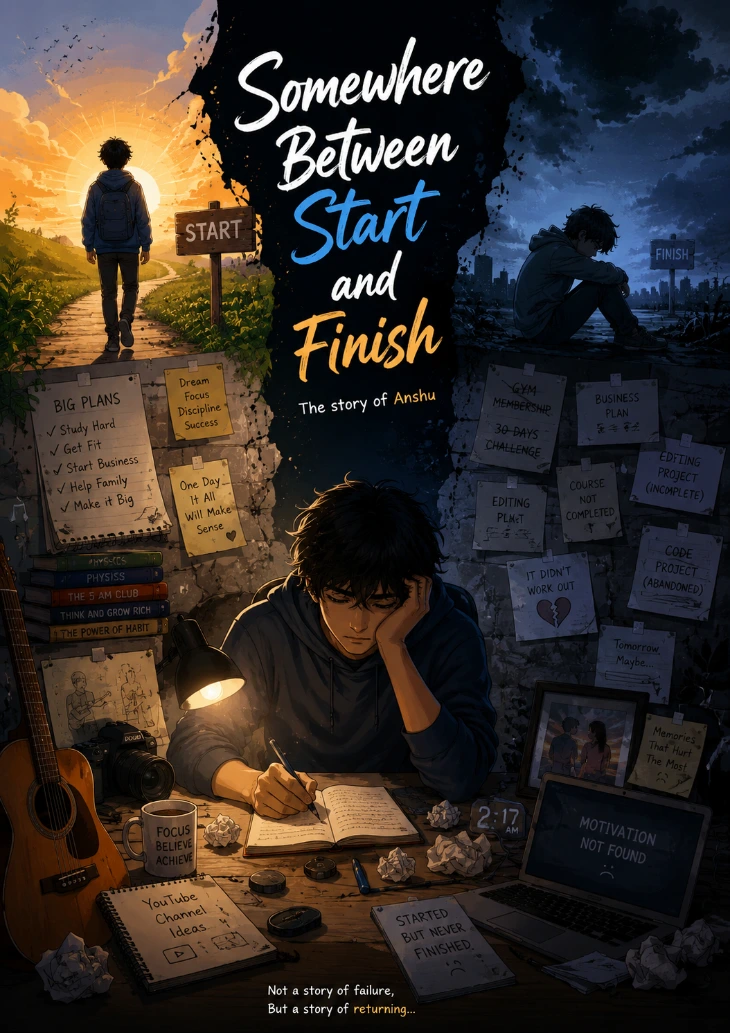
Somewhere Between Start and Finish.
Anshu always started like fire.
Not the kind that burns slowly, carefully, patiently.
No. His fire exploded.
Whenever he began something new, the whole world around him could feel it. His eyes would shine differently. His voice would become louder, faster, alive. He would wake up early, make plans, write goals on paper, watch tutorials all night, practice harder than everyone else.
And for some time, he looked unstoppable.
If he wanted to learn guitar, within two weeks he could already play songs that took others months.
If he decided to study, he topped mock tests.
If he started a business idea, people believed in him instantly.
If he loved someone, he loved with his entire soul.
But then…
Something always snapped.
Not loudly.
Not dramatically.
Just quietly.
One day he would stop replying.
Stop practicing.
Stop showing up.
Stop caring.
And slowly, everything he touched would die in the middle.
Again.
And again.
And again.
By the age of twenty-four, Anshu had become a graveyard of unfinished things.
Half-read books.
Dead YouTube channels.
Incomplete courses.
Gym memberships.
Business plans.
Relationships.
Dreams.
His room was full of beginnings.
But no endings.
People called him talented.
Some called him lazy.
Some called him distracted.
Some said he lacked discipline.
But nobody knew the truth.
Not even Anshu.
Because every time he stopped, he hated himself for it more than anyone else ever could.
Anshu lived in a small city where expectations entered a boy’s life before adulthood did.
His father worked in a government office. A tired man. Honest. Quiet. The kind of man whose back bends slowly under responsibility instead of age.
His mother believed in him too much.
That was the problem.
Mothers like her look at broken boys and still see kings.
“Tu bahut bada karega,” she would say while serving food.
You will do something great.
And every time she said that, Anshu felt fear instead of motivation.
Because deep down, he had started believing he was a fraud.
The strange thing was this:
Anshu was not weak.
He had survived things that should have broken him completely.
He survived his first heartbreak when the girl he loved told him he was “too unstable to build a future with.”
He survived financial pressure when his father’s salary got delayed for months.
He survived loneliness.
He survived watching his friends move ahead while he kept restarting life every six months.
He survived nights where he stared at the ceiling until sunrise wondering why his own mind betrayed him.
He was mature enough to understand life.
That’s what confused him.
He knew responsibility mattered.
He knew consistency mattered.
He knew discipline mattered.
Yet somehow, when the moment came to continue… he disappeared from his own life.
One winter evening, Anshu sat on the roof of his house holding a notebook filled with plans.
Again.
“Fitness routine.”
“Daily study hours.”
“Content creation strategy.”
“Business roadmap.”
Perfect handwriting. Perfect structure.
Perfect beginning.
He stared at the page for a long time.
Then suddenly he laughed.
A painful laugh.
“What’s the point?” he whispered.
He already knew what would happen.
For ten days he would become a machine.
For twenty days he would feel powerful.
Then one small problem would come…
A fight at home.
A bad day.
A memory of his ex.
Fear of failure.
Comparison.
One missed day.
And then his brain would say:
“It’s over now.”
That sentence ruined his life.
“It’s over now.”
One missed workout became quitting the gym.
One bad video became deleting the channel.
One argument became ending relationships.
One failure became disappearing entirely.
Anshu didn’t understand why his mind treated small breaks like permanent destruction.
He thought maybe he was born defective.
Months passed.
One afternoon, while helping his cousin clean an old bookstore, Anshu found a dusty novel with torn pages.
Inside the book, someone had written with blue ink:
“People don’t fail because they stop.
They fail because they think stopping means the story has ended.”
He read the line again.
And again.
Something about it disturbed him.
That night, he could not sleep.
For the first time in years, he stopped asking:
“Why do I quit?”
And started asking:
“Why do I think quitting once means I can never return?”
The question changed everything.
The next morning, he opened his laptop.
Not to start a new dream.
To revisit an old one.
Video editing.
He used to love it.
Two years ago he had learned faster than everyone around him. His edits were cinematic, emotional, alive. People genuinely believed he could make a career from it.
Then a breakup happened.
He stopped editing for one week.
That one week became two years.
Not because he lost talent.
Because somewhere inside his mind, he believed the streak was broken forever.
So instead of continuing imperfectly, he abandoned it completely.
Anshu sat frozen.
Suddenly memories flooded his head.
The gym.
The guitar.
The coding course.
The startup idea.
He had not actually failed most of them.
He had paused them.
But his ego translated pauses into death.
Because he only loved perfection.
That realization hurt more than failure itself.
Anshu was addicted to flawless beginnings.
He loved the first phase because beginnings have no proof of failure yet.
At the start, imagination protects you.
People praise your excitement.
You see endless possibilities.
Your identity feels powerful.
But continuation?
Continuation is ugly.
It requires repetition.
Boredom.
Embarrassment.
Slow progress.
Returning after bad days.
And Anshu never learned that part.
Nobody taught him.
Schools teach success.
Social media teaches motivation.
Movies teach talent.
But almost nobody teaches recovery.
The ability to continue after interruption.
The ability to restart without shame.
That is what separates dreamers from builders.
For weeks, Anshu thought deeply about his life.
And slowly he discovered another truth:
He was carrying invisible exhaustion.
Not physical exhaustion.
Emotional exhaustion.
Family expectations.
Financial pressure.
Breakups.
Comparison.
Fear of wasting potential.
He kept pretending he was “handling everything maturely.”
But maturity does not mean pain disappears.
Strong people can still become tired.
And tired minds seek escape.
His quitting was not laziness.
It was emotional overload mixed with perfectionism.
The moment life became heavy, his brain searched for relief.
And stopping gave temporary relief.
No expectations.
No pressure.
No possibility of failure.
Just silence.
But silence slowly became guilt.
And guilt slowly became identity.
Eventually, he stopped saying:
“I quit things.”
Instead he started saying:
“I am a loser.”
That sentence poisoned him.
Because once a person believes failure is their identity, they stop fighting temporary defeats.
One rainy evening, Anshu met an old school teacher near a tea stall.
The teacher smiled.
“What are you doing these days?”
Anshu looked away.
“Nothing much.”
The teacher laughed softly.
“You were always strange.”
Anshu smiled weakly.
“I still am.”
“No,” the teacher said. “You were never lazy. You were intense.”
That word stayed with him.
Intense.
Yes.
Anshu felt everything intensely.
Excitement.
Love.
Failure.
Embarrassment.
Pressure.
He lived life at emotional extremes.
That’s why he started with obsession and stopped with collapse.
The problem was not lack of ability.
The problem was sustainability.
He didn’t know how to live slowly.
That night Anshu wrote something in his notebook.
Not goals.
Rules.
Simple rules.
“Missing one day is normal.”
“Progress is allowed to look ugly.”
“I will return before guilt becomes identity.”
“I do not need dramatic motivation to continue.”
“Slow work is still work.”
For the first time in years, he did not try changing his entire life overnight.
He only edited one video.
The next day, thirty minutes more.
Some days he skipped.
But this time, he returned.
That was new.
Returning became his biggest victory.
Not perfection.
Not speed.
Return.
Months later, nothing magical had happened.
He was not rich.
Not famous.
Not fully healed.
But something inside him had changed.
He no longer worshipped beginnings.
He respected continuation.
And strangely, life started moving.
His editing improved again.
Clients slowly appeared.
His confidence returned quietly instead of explosively.
Even his relationships improved because he stopped disappearing emotionally whenever life became hard.
One day his mother entered his room and saw him working late.
She smiled the same old smile.
“Tu bahut bada karega.”
This time, Anshu did not feel fear.
Because now he understood something important:
Greatness is not built by people who never stop.
It is built by people who return.
Again.
And again.
And again.
Years later, Anshu would sit with younger boys who hated themselves the same way he once did.
Boys full of unfinished dreams.
And he would tell them:
“You think your problem is quitting.
But your real problem is shame.”
He would explain how dangerous perfectionism is.
How social media lies to people.
How everyone sees success stories but nobody sees the thousands of quiet returns behind them.
He would tell them:
“The world celebrates intensity because intensity looks cinematic.
But consistency is usually boring.
Real growth looks ordinary.”
And then he would say the thing he wished someone had told him earlier:
“You are not behind because you stopped.
You are behind because every time you stop, you bury yourself instead of restarting.”
Anshu never became perfect.
Even at thirty, he still struggled sometimes.
Some months he lost rhythm.
Some days old thoughts returned.
But now he understood his mind.
And understanding changed everything.
He stopped fighting himself like an enemy.
Instead, he built systems around his weakness.
Small goals.
Daily structure.
Limited expectations.
Rest without guilt.
Progress tracking.
Emotional honesty.
Most importantly, he stopped making his self-worth dependent on performance.
That saved him.
Because when a person believes they are worthy only while succeeding, they eventually fear trying.
If you ask what Anshu should do in the future, the answer is simple but difficult.
He must stop waiting to “feel ready.”
Life is not completed by motivation.
It is completed by repetition.
He must understand that interruptions are part of growth, not proof of failure.
He must learn to continue while imperfect, tired, confused, heartbroken, uncertain.
Because adulthood is not about feeling powerful every day.
It is about carrying responsibility even on ordinary days.
And most importantly:
He must forgive himself.
Not once.
Many times.
Because boys like Anshu are often destroyed not by failure…
…but by the hatred they develop toward themselves afterward.
Anshu’s story is not rare.
Millions of people live exactly like him.
Brilliant beginnings.
Broken continuations.
But hidden inside people like Anshu is something powerful:
The ability to become unstoppable once they learn emotional balance.
Because quick learners already have talent.
What they lack is stability.
And stability can be learned.
Slowly.
Patiently.
Imperfectly.
One final night, years after the boy on the rooftop laughed at his own plans, Anshu opened that same old notebook again.
The pages looked different now.
Not cleaner.
Not perfect.
But fuller.
Some goals were crossed out.
Some failed.
Some completed halfway.
Some transformed into something else entirely.
And for the first time in his life, unfinished things did not make him feel ashamed.
They made him feel human.
He looked out the window quietly.
The city was sleeping.
His father was coughing in the next room.
His mother had left food covered on the table.
Life was still difficult.
But he finally understood something most people learn too late:
A successful life is not built in one perfect run.
It is built through thousands of small returns after thousands of small collapses.
And maybe…
Maybe that was enough.
Maybe the boy who always stopped in the middle was never truly a loser.
Maybe he was simply a human being learning how to continue.
:- Ayush Raut